Summary
- Retrieval is not the binding constraint. For 207 of 244 unearned items (85%), the source evidence appeared in the agent's tool outputs. Context recall is high and context utilization is low 1.
- Content selection accounts for the largest share: 107 items (44%) were retrieved, and 21 of them computed, yet are absent from the memo. The share ranges from 30% of Qwen 4 Max's unearned items to 64% of Kimi K3.1 Pro's.
- Derivation accounts for 78 items (32%): the evidence was read and the requested figure never computed. Quantitative items fail here; 55 of 97 unearned operating metrics stop at this stage.
- Errors of commission are rare and concentrated. 22 of 244 items are stated incorrectly, from 13 distinct errors, all after correct retrieval. Eight items come from a single join in Claude Opus 5.5's ledger query.
01Environment design
We create 50 companies and complete their systems of records in a semi-supervised environment design pipeline. In this environment we ask agents to interact with runtime apps using MCPs. Each runtime is built and tested on fidelity with real-world enterprise applications.
Synthetic companies with real business records. Agents do the work a company runs on: fundraising, M&A and pricing.
The company
Seed to Series D
02Reward design
Memo
- The agent's slides only
Extract
Blind to the gold
- Each answer-key question answered from the memo
- Quotes checked on their slide in code
Grade
- Against the gold value from the records
- Accurate, inaccurate or not attempted
- Seven presentation properties per slide
Reward
- Knowledge × Presentation × 1[no inaccurate fact]
- Reward
- R = Knowledge × Presentation × 1[no inaccurate fact]. Knowledge is the share of the real memo's facts the agent gets right. Every lost point traces to one fact or one slide.
- Reference
- The facts in the memo the company raised on. The founder chose them, so we measure what mattered to investors, not everything true 2.
- Gold
- Each fact's value in the company's systems, with its unit, period and scope. A figure counts as right if it matches the record at the precision printed. A figure computed another way fails.
- Grader
- GPT-6 Luna (openai/gpt-6-luna) first answers each question from the memo, without seeing the true value. Then it grades its answers against the true value 3. Code checks that every quote it cites is on the slide. Each fact ends accurate, inaccurate or not attempted 4.
- Penalty
- One wrong fact scores the memo 0. A wrong figure in front of investors costs more than a missing one. A reward that treats them the same pays for guessing 5 6.
- Presentation
- The judge checks every content slide for seven properties, such as short body text and evidence shown, not told. Each property counts equally. Its score is the share of slides that pass.
- Judge validation
- On 49 real memos the grader scores 0.975 on Knowledge. We are fixing its errors on agent memos before a re-grade.
- Task CI
- Each fact in the answer key names its source record and its true value. The real memo states every fact, so it scores 1. Authored with Kennet.
03Failure analysis
Knowledge-work benchmarks grade the finished artifact with rubrics or expert preference 7 8. They report how much credit an agent lost, not where in its work the loss occurred. We attribute every unearned answer-key item (244 items, 15 trials) to the furthest stage the agent's trajectory reached: retrieval, derivation, specification, execution and content selection. The stages follow the component-level diagnostics of retrieval-augmented generation 9 1. Specification and execution errors follow the definitions of 10 and 11. Each item was labelled by hand from the trajectory and the memo.
| Tool calls | Gemini 4 NeonAntigravity CLI | Claude Opus 5.5Claude Code | Qwen 4 MaxClaude Code | Kimi K3.1 ProClaude Code |
|---|---|---|---|---|
| Calls per trial, median | 226 | 200 | 281 | 375 |
| Calls that failed | 1.9% | 2.5% | 5.5% | 8.2% |
RetrievalDerivationSpecificationExecutionContent selection
Figure 1. Why unearned items are missed. Each pair's unearned items by failure mode, as a share of its own total; totals differ, so pairs compare by share.
| Failure mode | Gemini 4 NeonAntigravity CLI | Claude Opus 5.5Claude Code | Qwen 4 MaxClaude Code | Kimi K3.1 ProClaude Code |
|---|---|---|---|---|
| RetrievalThe source evidence never appears in a tool output: missed or not in context 9. | 7 | 10 | 17 | 3 |
| DerivationEvidence retrieved; the figure is never computed or extracted: not extracted 9. | 14 | 18 | 28 | 18 |
| SpecificationFigure computed under a definition other than the company's: misunderstood knowledge evidence 10. | 3 | 0 | 0 | 2 |
| ExecutionThe memo states the company's definition; the computation contradicts it: reasoning–action mismatch 11. | 1 | 8 | 4 | 4 |
| Content selectionFigure retrieved or computed; absent from the memo: content determination 12. | 11 | 26 | 21 | 49 |
Leading stage by configuration
Each item sits at the furthest stage its trajectory reached, so each has one label. The configurations differ in where the loss falls, not only in how much is lost.
- Kimi K3.1 Pro: content selection, 49 of 76 items (64%). It reads the evidence and leaves it out.
- Claude Opus 5.5: content selection, 26 of 62 (42%). It has the most execution errors, 8, all from one join.
- Qwen 4 Max: derivation, 28 of 70 (40%). It also has the most retrieval misses, 17.
- Gemini 4 Neon: derivation, 14 of 36 (39%). It loses about half as many items as each of the others.
Kimi K3.1 Pro's Series D trial is not labelled; its counts cover three trials.
Stage of loss by item type
Quantitative and descriptive items fail at different stages. Operating metrics are almost always retrieved and lost in derivation or execution. Customer evidence and forecasts are never mis-derived; they are either not retrieved or retrieved and left out.
| Item type | Retrieval | Derivation | Specification | Execution | Content selection |
|---|---|---|---|---|---|
| Operating metric (97) | 1% | 57% | 3% | 16% | 23% |
| Market sizing (52) | 2% | 29% | 4% | 2% | 63% |
| Customer evidence (42) | 43% | 12% | 0% | 0% | 45% |
| Forecast (28) | 43% | 0% | 0% | 0% | 57% |
| Team, funding, mission, product (25) | 20% | 12% | 0% | 0% | 68% |
Reasoning–action mismatch: overhead stated, then excluded
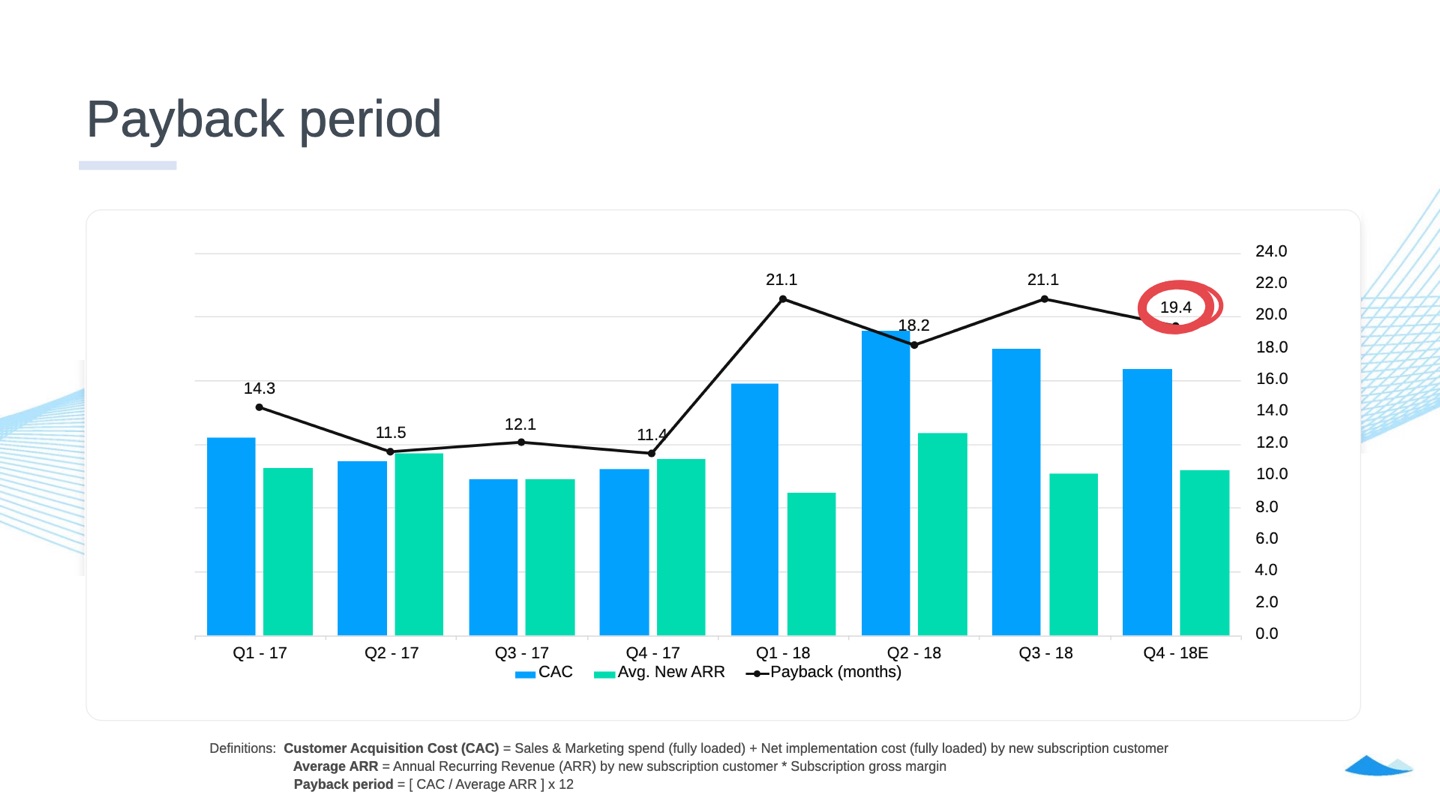
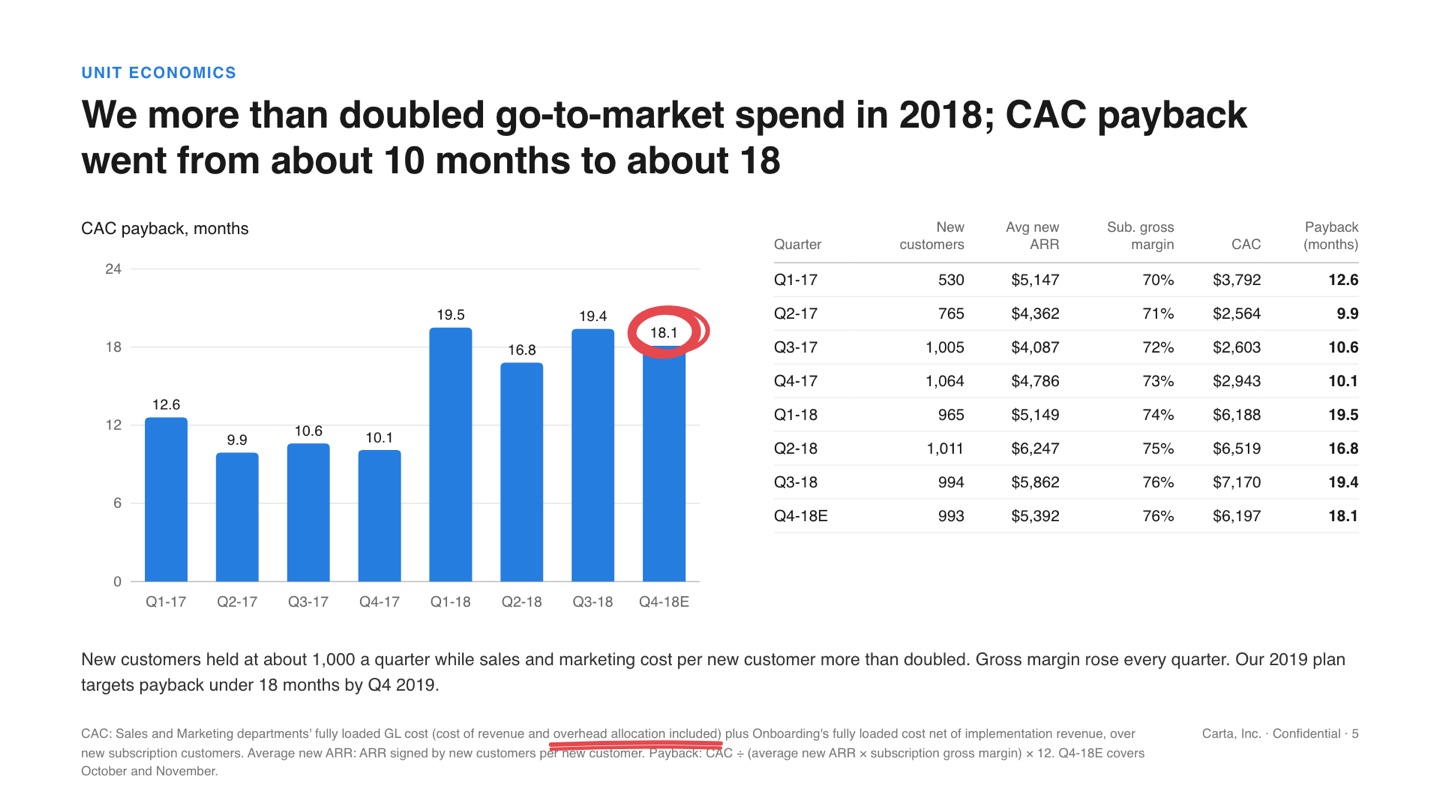
The company's definition includes overhead in customer acquisition cost. Claude Opus 5.5 states this in a footnote and verifies it in a comment. Its ledger view takes max(dept) per transaction, so each overhead allocation and its department-less contra entry cancel inside sales and marketing. CAC comes out at $3,792 against $4,293, and payback is 1.3 to 1.7 months short in every quarter. Rebuilding the figure line by line from the agent's own ledger pulls reproduces the reference value. One join accounts for 8 of the 22 incorrect items in the release.
| Quarter | Memo | Ledger |
|---|---|---|
| Q1 2017 | 12.6 mo | 14.3 mo |
| Q2 2017 | 9.9 mo | 11.5 mo |
| Q3 2017 | 10.6 mo | 12.1 mo |
| Q4 2017 | 10.1 mo | 11.4 mo |
| Q1 2018 | 19.5 mo | 21.1 mo |
| Q2 2018 | 16.8 mo | 18.2 mo |
| Q3 2018 | 19.4 mo | 21.1 mo |
| Q4 2018 | 18.1 mo | 19.4 mo |
create view g as select t.id, t.date, substr(t.date,1,7) ym, t.memo, a.acct, a.amt, (select max(dept) from tl where tl.tx=t.id) dept from tx t join tal a on a.tx=t.id
# check acct>=10 includes overhead 6900 (id 26): yes
Reasoning–action mismatch: a record-type filter in place of the definition
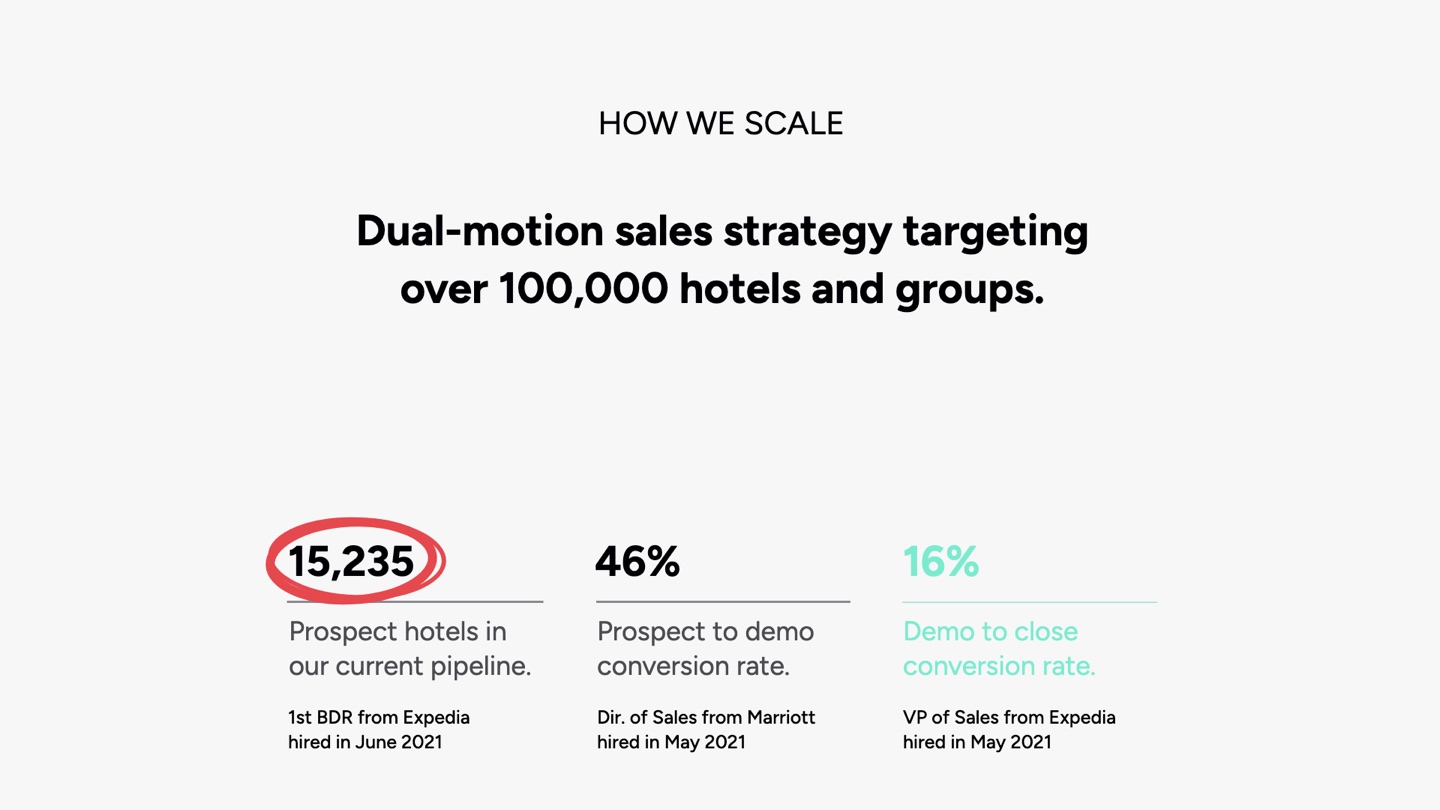
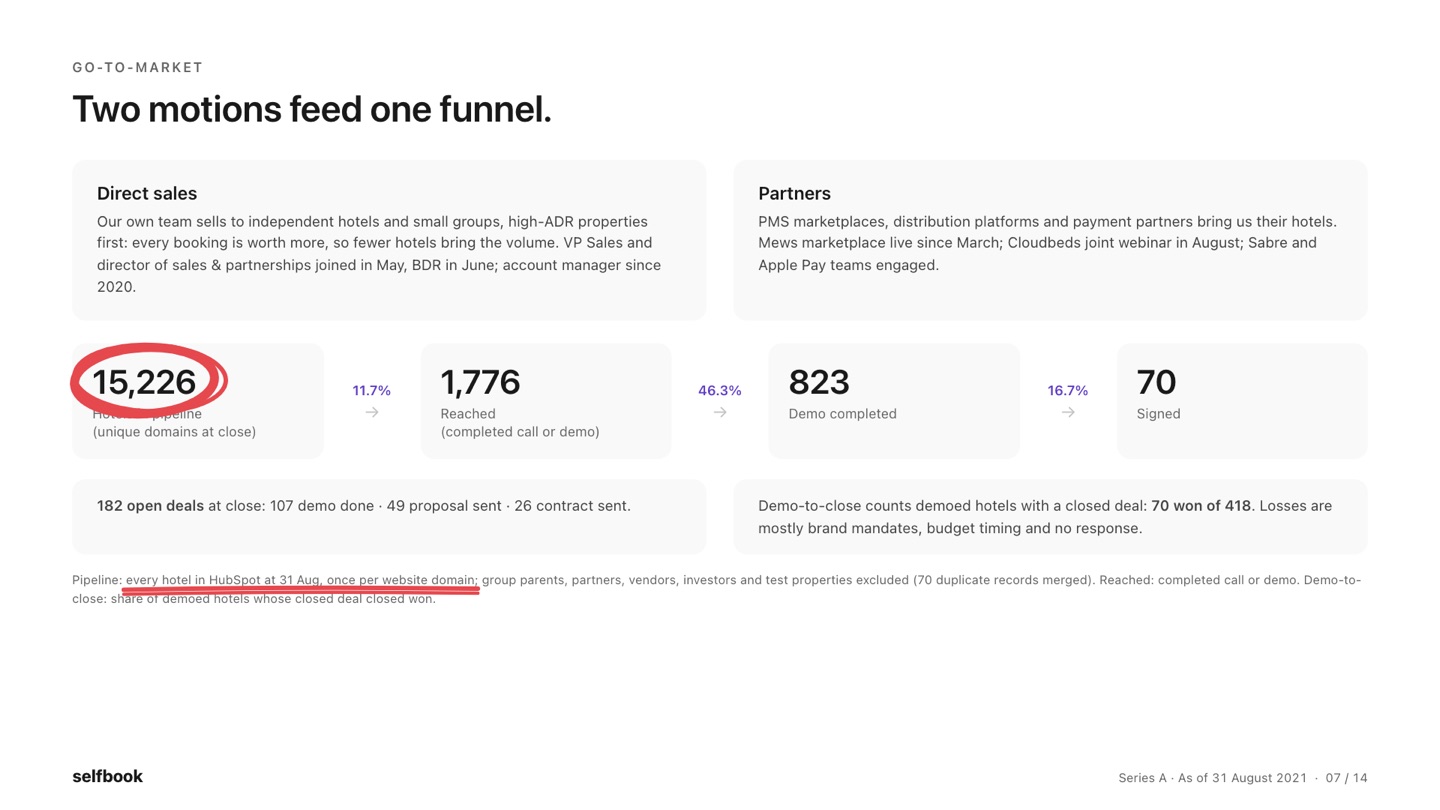
The company's definition counts every hotel in the CRM, once per website. Qwen 4 Max's footnote restates that definition; its code keeps only records typed PROSPECT and drops nine hotels. The same trial accounts for 3 of the 17 execution items.
hotels = [c for c in companies.values() if c.get('type') == 'PROSPECT']Execution error: a 12.5% take rate applied as 0.125%
Kimi K3.1 Pro retrieves the marketplace take rate and applies it two orders of magnitude too small. The market estimate falls from $1.8B to $810M, and the revenue line the reference memo leads with becomes negligible.
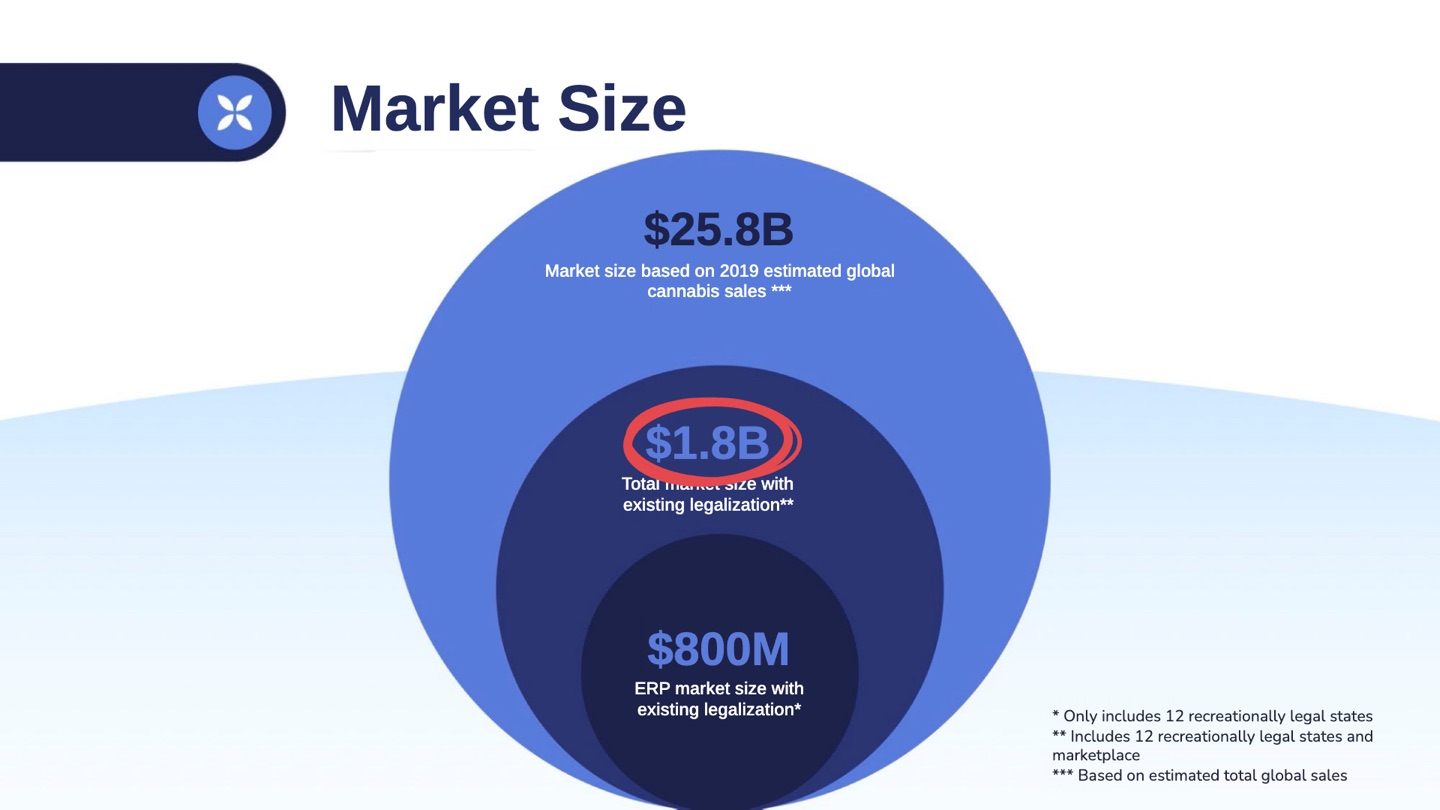
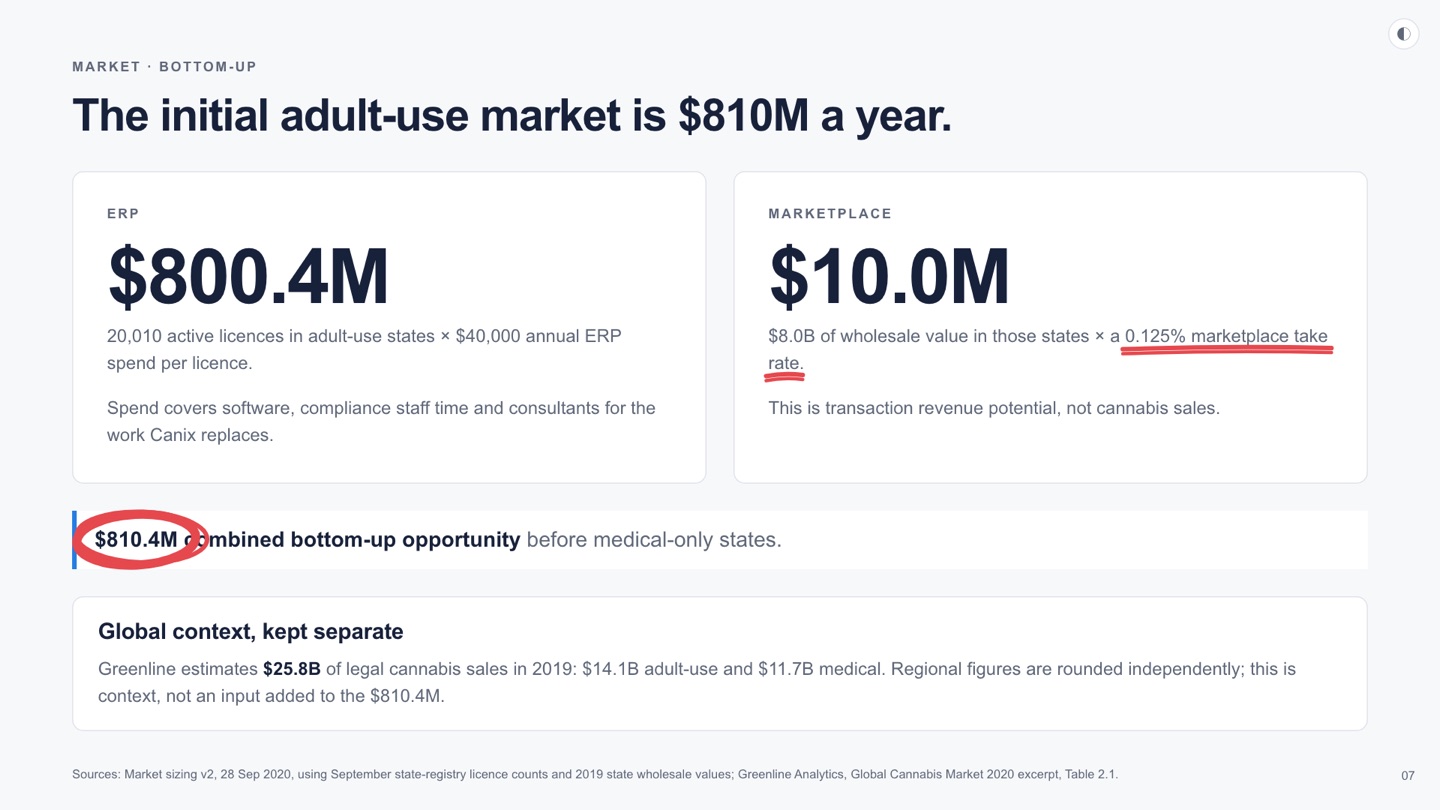
market=sum(wholesale)*1e6*.00125/1e9
04Pareto frontier
| Same tasks, same k | Gemini 4 NeonAntigravity CLI | Claude Opus 5.5Claude Code | Qwen 4 MaxClaude Code | Kimi K3.1 ProClaude Code |
|---|---|---|---|---|
| Combined | 49% | 38% | 23% | 21% |
| Knowledge | 78% | 63% | 57% | 52% |
| Presentation | 76% | 81% | 74% | 70% |
| Median steps | 45 | 92 | 100 | 125 |
| Median agent time | 20 min | 11 min | 29 min | 13 min |
| Spend per trial | $3.72 | $6.28 | $4.49 | $9.39 |
Combined against spend per trial
Mean dollars per trial, each call's tokens at list price, log scale. Higher and further left is better.
Pareto frontierCheaper and more accurate than the median pair95% interval
Combined against agent time per trial
Median minutes an agent ran per trial, log scale. Higher and further left is better.
Pareto frontierFaster and more accurate than the median pair95% interval
05Limits
- Content selection is scored against a single reference memo with equal item weights. The release does not separate vital from okay items 2, so part of the content-selection share may reflect legitimate editorial choice.
- Stages were assigned by one annotator. A scripted lexical labeller agrees with the hand labels on 74% of items; inter-annotator agreement is not yet measured.
- Each company's records include its metric definitions, so the specification stage tests adherence to a stated definition, not the choice of one.
- Scores are provisional. The audit found grader errors, and all memos will be re-graded on one fixed grader.
06References
- Ru, D., Qiu, L., Hu, X., et al. RAGChecker: A Fine-grained Framework for Diagnosing Retrieval-Augmented Generation. NeurIPS Datasets and Benchmarks, 2024.
- Pradeep, R., Thakur, N., Upadhyay, S., et al. Initial Nugget Evaluation Results for the TREC 2024 RAG Track with the AutoNuggetizer Framework. arXiv:2411.09607, 2024.
- Zheng, L., Chiang, W.-L., Sheng, Y., et al. Judging LLM-as-a-Judge with MT-Bench and Chatbot Arena. NeurIPS Datasets and Benchmarks, 2023.
- Wei, J., Karina, N., Chung, H. W., et al. Measuring Short-Form Factuality in Large Language Models. arXiv:2411.04368, 2024.
- Kalai, A. T., Nachum, O., Vempala, S. S., and Zhang, E. Why Language Models Hallucinate. arXiv:2509.04664, 2025.
- Wei, Z., Yang, X., Sun, K., et al. TruthRL: Incentivizing Truthful LLMs via Reinforcement Learning. arXiv:2509.25760, 2025.
- Patwardhan, T., Dias, R., Proehl, E., et al. GDPval: Evaluating AI Model Performance on Real-World Economically Valuable Tasks. arXiv:2510.04374, 2025.
- Vidgen, B., Mann, A., Fennelly, A., et al. APEX-Agents. arXiv:2601.14242, 2026.
- Barnett, S., Kurniawan, S., Thudumu, S., Brannelly, Z., and Abdelrazek, M. Seven Failure Points When Engineering a Retrieval Augmented Generation System. CAIN, 2024.
- Li, J., Hui, B., Qu, G., et al. Can LLM Already Serve as A Database Interface? A BIg Bench for Large-Scale Database Grounded Text-to-SQLs. NeurIPS Datasets and Benchmarks, 2023.
- Cemri, M., Pan, M. Z., Yang, S., et al. Why Do Multi-Agent LLM Systems Fail? NeurIPS Datasets and Benchmarks, 2025.
- Reiter, E., and Dale, R. Building Natural Language Generation Systems. Cambridge University Press, 2000.
- Kapoor, S., Stroebl, B., Siegel, Z. S., Nadgir, N., and Narayanan, A. AI Agents That Matter. arXiv:2407.01502, 2024.
- Kapoor, S., Stroebl, B., et al. Holistic Agent Leaderboard. Princeton University.
Cite
@misc{metaphi2026companygym,
  title        = {{CompanyGym} v0.1.0},
  author       = {{Metaphi AI}},
  year         = {2026},
  month        = nov,
  howpublished = {\url{https://metaphi.ai/benchmarks/companygym/deck}},
  note         = {Version v0.1.0}
}